So, I ended up purchasing the Logitech Harmony 1100 universal remote and my experience pretty much was the same as everyone else on line.
I got it on sale at Best Buy for $286. It had been as much as $500 when it first came out and as low as $249 in recent weeks. For the record, I think this is about what this device should cost as it is very unique.
First the bad...set up is really tough. As you may know, you have to make any changes through software that comes with the device. The software does not work with the latest Mac or Windows 7 operating systems (how can that be?) and has some bugs in it. After a couple of hours reading work arounds on line, I decided to talk to customer support. Even though it says that they are open on Sunday, they are not and even though it says they open at 9am EST, they do not. After an hour on hold, I finally talked to someone in India, who could not solve the issue with input changes to my new Insignia TV.
Later in the day, I received a call from a nice tech support rep in Canada, who fixed the issue. Logitech claims that they work with every device out there, but not really as so far they don't work right with Insignia, Mac or Windows 7. The non-compatible with Mac OS Lion really gets me...
Anyway, after a solid day of troubleshooting, the device works great. I'd say the coolest part is the favorites option which allows you to push a button to go to your favorite channel, listed by logo on the touch screen. They did not have the logos, but directed me to the site www.iconharmony.com to download TV channel icons for free.
I hear from other posts on line that the Harmony 1100 is not meant to be tossed around, so I also bought the Best Buy replacement service. We will see about that.
Bottom line, The Harmony 1100 is a one of a kind product that makes your home theater set up look very cool. Everyone I have shown this too, really likes it, but thinks it's lot of money. Once you get through the difficult set up, it works as advertised.

Reviewing everything about personal technology. Computers, mobile phones, Apps, TVs, games, social media, services, websites...anything having to do with your life and technology.
Tuesday, November 8, 2011

Thursday, October 20, 2011
Why Google doesn't (and shouldn't) care about tablets yet
 |
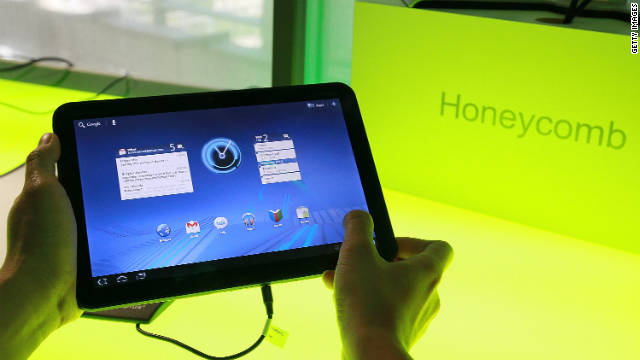
Google's Android 3.0 Honeycomb OS is demonstrated on a Motorola Xoon tablet.
STORY HIGHLIGHTS
- Tablets are all anyone can talk about right now, from Apple to Amazon
- Google recently introduced Ice Cream Sandwich, which is their unified mobile OS
- Tablets just aren't that big a part of Google's business, nor are they likely to be
(WIRED) -- Google held two big events within 24 hours: one with its subsidiary Motorola in New York, and another with its partnerSamsung in Hong Kong.
While there was some loose speculation around the web that maybe we'd see a new Xoom tablet or a preview of the next Galaxy Tab running Android's new Ice Cream Sandwich operating system, the focus was rightly on what Google, Motorola and Samsung do best: making really great Android smartphones.
Ice Cream Sandwich is billed as Google's unified mobile OS, working the same way on both tablets and smartphones. So far, though, what that means (as Google's Hugo Berra wrote after Google I/O this summer) is that "Ice Cream Sandwich will bring everything you love about Honeycomb on your tablet to your phone."
It's about making the phone experience bigger, more interactive, more capable. It's about making the phone literally bigger -- theGalaxy Nexus has a 4.65″, 1280 by 720 pixel screen, which while not unprecedented, is still really big for a smartphone, and way bigger than the 3.7″ Nexus One screen.
Motorola, too, continues to treat the smartphone as the center, not periphery, of a new computing economy. It builds out its Droid RAZR with the Motoactv media player, dedicated cloud syncing and backup, and a range of docks and peripherals that all communicate with and augment the computing power of the handset.
The PC used to be the command center of your digital life; now, it's the phone. Anything with a hardware keyboard is again relegated to the role of a specialized workstation.
But wait; what about tablets? Tablets are supposed to be the devices that bridge phones and PCs. They're all anyone can talk about. Everybody loves tablets now:
-- Apple sold eleven million iPads last quarter;
-- Manufacturers tripped over themselves to pump out tabletsbefore a tablet-optimized version of Android was even ready (and continue to do so, even though Google hemmed and hawed about making Honeycomb's source code available);
-- Amazon's coming out with one (you probably heard about it);
-- HP incited tablet fever when it slashed prices to clear Touchpad stock;
-- Even global e-reading company Kobo has a brand-new Android tablet, the Vox, that will probably ship before Amazon's Kindle Fire.
So what's going on here? Why isn't Google embracing this, racing to get out ahead of the tablet market, pushing the envelope on pricing and capabilities, and generally looking to disrupt the whole show?
Ultimately, tablets just aren't that big a part of Google's business, nor are they likely to be. Google-approved Honeycomb tablets have only sold an estimated 3.4 million devices total.
Nor have tablets been a top priority within Google for very long. Android's head of user experience Matias Duarte told This Is My Next's Joshua Topolsky that Honeycomb was an "emergency landing," a crash-the-plane-in-a-cornfield attempt to stop manufacturers from shipping Android tablets with artificially up-sized smartphone builds: "Any corner we could cut to get that thing out the door, we had to." He explains, "That's the sole reason we haven't open sourced it."
Ice Cream Sandwich finally opens up pieces of the new platform to everyone, but the focus is decidedly not on tablets, at least for Duarte: "Ice Cream Sandwich is where we say 'huh, okay, how are those changes [first introduced in Honeycomb] going to work on phones?'" It may not be until Android Jelly Bean that we see Google's full attention turn to tablets, if then.
It may seem like I'm being harshly critical of Google or Android. Actually, I'm not. So I'll spell it out: Google moving slowly into tablets while it focuses on smartphones makes perfect sense. It's smart. It's good strategy. It fits perfectly with where Google is today and how it needs to position itself tomorrow.
Tablets are overwhelmingly consumer media devices. They can do many other things, and there's some room for very specialized devices for the enterprise market. At their broadest base, though, tablets are best for sitting on the couch and reading books or magazines, browsing the web, playing games and watching video. This is why Apple, the quintessential consumer electronics and media company, has been very successful with them. It makes money from selling the shiny package, and it makes money again from filling it up with apps and media.
It's possible to outsource the electronics bit, but not the media bit or the consumer focus. This is why Barnes & Noble has been fairly successful with the Nook Color, and Amazon will probably be quite successful with the Kindle Fire. These companies can tailor Android for their own purposes and use them as remote digital retail outposts.
Until very recently, Google was neither a consumer electronics nor a media company. It's a search, communications, advertising, software and services company. If you look at their existing line of applications, only a few, like Gmail, Maps or YouTube, make a lot of sense for tablets. The vast majority of their apps, from search to document editing, make much more sense on either a traditional PC, a smartphone or something like a Chromebook.
Real media companies -- that is, content companies -- haven't been able to figure Google out. That, at least, is what Android chief Andy Rubin told Walt Mossberg Wednesday at the AsiaD conference.
"Google is in the very, very early phases of adding consumer products to our portfolio," Rubin said. "The media industry didn't see us as that. They saw us as a search company."
Over time, that could change. The landmark Google Books agreement, now at a lawsuit-imposed standstill, could be retooled and resurrected. YouTube and Google TV may become vehicles for original or licensed content to compete with Hulu or Netflix. Google's nascent efforts in music could really take off. And Google could continue to treat all its Android handset makers equally while continuing to use Motorola as its officially sanctioned tablet manufacturer, bringing something unique and distinctive to those devices.
Until then, Android tablets will be a solid value proposition for media retailers like Amazon, Barnes & Noble or Kobo, and a much less attractive one for Google itself than smartphones or even Chromebooks.
So stick with phones, Google, at least for now. You're getting really good at this.
Wednesday, October 12, 2011
Why iOS 5 is a big deal


commentary While most of this week's attention is going to be on Apple's newiPhone 4S and how it sells, the most important thing to come out of the company is a new version of its iOS software, which arrives tomorrow.
iOS 5, which made its debut at Apple's Worldwide Developers Conference in June, marks a turning point for the company's mobile software. Yes, it's largely a collection of tweaks, improvements, and fiddling with a tried and true formula, but it's also one that--for the first time--breaks iOS devices apart from computers running Apple's iTunes software and goes further to try to unify the devices into the same family.
That vision is miles away from where Apple's iPhone journey started and a response to the fact that iOS has long since rocketed past the company's computers in popularity, with devices like the iPad growing to compete directly. No, this isn't a "Mac OS X is dying" post, as much as now is a very good time to point out that what may seem like just another software update is something much bigger in the grand scheme of things.
The "PC Free" era
For the last four major versions of iOS, stretching all the way back to the original iPhone, Apple has demanded that users plug into a computer--be it a Mac or PC--to sync music, ferry over data, and grab software updates. Now those features are built into iOS itself.
For the last four major versions of iOS, stretching all the way back to the original iPhone, Apple has demanded that users plug into a computer--be it a Mac or PC--to sync music, ferry over data, and grab software updates. Now those features are built into iOS itself.
Of course, if you have a computer, you can still plug in your device and continue to use iTunes, but Apple's big idea is that these devices now stand on their own, right out of the box. That's further augmented by a new wireless sync feature built intotoday's iTunes 10.5 software update and iOS 5 that lets users continue to sync with their computer as they always have, but without the wires.
Related stories
•A brief tour of Apple's iOS 5
•15 iOS 5 tips and tricks
•New iOS 5 features compared to Android, BlackBerry, Windows Phone
•iOS 5 How To roundup
CNET TV: iOS 5's hidden features
•A brief tour of Apple's iOS 5
•15 iOS 5 tips and tricks
•New iOS 5 features compared to Android, BlackBerry, Windows Phone
•iOS 5 How To roundup
CNET TV: iOS 5's hidden features
To get to the "PC free" era, as Apple's calls it, the company's gone through each built-in application to make sure it can function fully without the need for a computer running iTunes. Apple laid the groundwork for that in previous system software updates, letting users download content from the iTunes Store directly onto devices. But where that was largely a ploy to encourage people to make more content purchases, this move takes the decoupling approach system-wide to make the hardware more appealing to those who wish it exclusively. That amounts to things like letting users delete media that's been synced over from a computer, as well as editing photos that have been snapped on the device.
In order to make what could be considered a sacrifice of decoupling it to iTunes, Apple's tied it to something else: iCloud. That's Apple's new cloud-based service that both stores and ferries files from one iOS device to another.
Launching tomorrow alongside iOS 5, iCloud does many of the same things as MobileMe (the service it's replacing), while adding new hooks like:
- A back-up service that can store near-full copies of your iOS device on Apple's servers for safe keeping
- The capability to re-download previously purchased content from any one of Apple's digital stores
- A feature called Photo Stream that transfers photos from one device to another in the background
- File storage for app developers to keep certain files, like documents or application settings
Collectively, the service acts as a safety net for some of the things consumers originally needed a computer for when using these devices, something Apple is banking on to be attractive for users with one iOS device, or many.
Giving notifications another go
Perhaps just as important as the iCloud integration is how iOS 5 changes the way users get work done on Apple's mobile devices, albeit in a subtle way.
Perhaps just as important as the iCloud integration is how iOS 5 changes the way users get work done on Apple's mobile devices, albeit in a subtle way.

iOS 5's notification center.
(Credit: Jason Cipriani)Largely gone are the notifications that would pop up and completely take over the focus of whatever you were doing on the phone. You can still have those if you want, but the new default is a considerably smaller banner that folds down and gives you information from that app, then folds back away a few seconds later to reveal the portion of the application you were using when it came in.
These banners have been sized so that you can continue to use the application's menus even when they fold down, letting you continue to do whatever you're doing, or tap them to hop straight to the app you just got a ping from.
Joining the new notification banners is a new pull-down menu that lets you see a rundown of these messages in case you missed one, or want to come back to it later since you were using another application. This ends up creating a new multitasking workflow, letting users check for new updates from applications without leaving the one they're on. To Google's credit, it got here first with Android, and iOS users now get to reap the same productivity benefits that system brings.
All this may seem like a minor visual change, but it has a marked effect given that mobile apps on iOS still demand to be used on screen one at a time. For instance, if you're inside a news reading app and you get a new e-mail, you can swipe your finger down the screen and get the same kind of preview you'd get looking at your e-mail inbox. Third-party app developers also have the same opportunity as Apple to put those notifications right in front of users too.
Bringing it all together
With iOS 5, Apple's also taken additional steps in unifying the iOS platform, bringing what is largely the same version of the software to all its recent model devices at once.
With iOS 5, Apple's also taken additional steps in unifying the iOS platform, bringing what is largely the same version of the software to all its recent model devices at once.
If you think back to what it's been like for GSM and CDMA iPhone users with iOS 4, CDMA users have been left out of several software goodies. iOS 5 represents a different approach, with all users with recent models getting the same version of the software (minus things like Siri, which is an iPhone 4S exclusive). It remains to be seen whether that updating habit will continue in the minor software updates to come, but Apple now gets to start with a clean slate across all its devices.

iOS 5 features working on the iPod Touch, the iPad and the iPhone.
(Credit: Apple)Further playing into the idea of one big platform is iMessage, Apple's new messaging protocol. Like Research In Motion's BlackBerry Messenger platform, iMessage is a proprietary client that uses data to let iOS users send messages to one another, just like the iPhone's SMS app always has. For the first time, this lets iPod Touch and iPad users message through a first-party application, while acting as an alternative for iPhone users who previously had to go through carrier-supplied SMS and MMS services in Apple's SMS app.
While iOS users could have picked up third-party messaging apps, and IM clients, iMessage is special in that there's the basic promise that everyone with iOS will have it. Like iCloud, it's also a reason for users to lock into Apple's system, and stick with it since they have the potential to save money on text messaging fees.
With all these things put together, iOS represents a formidable update. While it's not quite the sea change that was iOS 4's multitasking update last year, it goes just about as far in giving those with existing iOS devices new ways to use them and takes those last few steps in making iOS a stronger standalone platform, something that's going to be very important if other devices join the iOS family later on down the line.
Subscribe to:
Comments (Atom)